The Schoolmen’s Club was organized on December 10, 1902. Active membership was limited to male teachers. The object of this Club was the promotion of the best interests of its members socially and professionally. Membership was divided into three Categories:
- Active membership : Limited to men employed by the Newark Board of Education, as teachers.
- Associate membership: Includes men who were teachers but were promoted to non teaching positions, men who are employed by the Board of Education in a supervisory or other non teaching position, men who are teachers but have not become members of the Club or withdrew from membership.
- Honorary: men who have been members in good standing and have retired from active school work.
On January 7, 1903 the group reconvened to elect officers. From that date forward it was ordered that all regular meetings be held on the Fourth Saturday evening of October, January, February and April at 8 o’clock. An annual meeting for the election of officers was to be held in February. Special meetings may be held at the call of the President of the Club. This meeting also produces three resolutions:
- “The proceedings of the meetings, the discussions and social interactions of its members shall be withheld from the press, the public and all persons, excepting so much as shall be officially promulgated. Any member divulging any of the proceedings, discussions or social interactions of the Club to any person or persons, shall be deemed to have Committed an ungentlemanly, unprofessional act , and upon proper proof shall be expelled”.
- “For the purposes of giving proper publicity to its official acts, there shall be appointed a committee of three to be known as the Press Committee, who shall have the sole charge and right to give to the press all information not prejudicial to the Club or its members”.
- “There shall be a committee of three to be known as the Legislative Committee. Said committee to make arrangements for obtaining all acts introduced into the Legislature relating to the school laws of this state, and consider them: and when in their judgement necessary , report to this club for further instructions. They shall be authorized and empowered to attend the sessions of the Legislature, when in their judgement conducive to the welfare of the Club and its members”.
When the Club’s Constitution and By – Laws were adopted, the first resolution pertaining to “ungentlemanly” behavior that could result in expulsion was not memorialized in print.
Four Committees were appointed:
- Legislative Committee
- Press Committee
- Banquet Committee
- Memorial Committee
“There shall be regular standing , or special, Committees as from time to time shall be authorized by resolution of the Board of Governors and for such purposes as named in the resolution. Such shall be named by title … as they from time to time shall be appointed”.
The Schoolmen’s Club began placing bronze commemorative tablets in Newark in 1911. Few other cities, if any, have systematically highlighted their history in this way. Of the fifty plus historical tablets to be found in Newark most were erected by the Schoolmen’s Club. The idea is credited to Arthur V. Taylor, one time chairman of the Latin department at Barringer High School.
In the Summer of 1910 Mr. Taylor was visiting in Deerfield, Mass. In the Deerfield Museum he came upon a tablet which paid tribute to “Mr. John Catlin, 65*** One of the Founders of Newark, N.J., 1665. He Came to Deerfield, 1683*** One of the Progenitors of the Deerfield Catlins, He was Killed in Defending Their Ancestral Home.”
Mr. Taylor came back to Newark and consulted with Frank J. Urquhart, an editor of the Newark Sunday Call and an author of an elaborate history of Newark, which was revised and reprinted by the Newark Board of Education to use as a text in Newark Schools. Mr. Urquhart told him that this Mr. Catlin was undoubtedly Newark’s first schoolmaster, whose career after he left this town in 1683 had until Mr. Taylor’s discovery had been unknown.
At the next meeting of the Board of Governors Mr. Taylor proposed the erection of a tablet to Catlin. The proposal was accepted, funds were appropriated, the tablet made and permission obtained to erect it at Broad and Commerce Street, not far from where Catlin’s schoolhouse had stood.
The inscription was prepared by Taylor, and the tablet was dedicated on November 6, 1911, which was called “Newark Day” by special enactment of the Board of Education. In later years Newark Day was transferred to May. It may be added that the tablet was unveiled by a little girl, Margaret Catlin Franchere, a great-great-great granddaughter of John Catlin. It was always the custom of the Schoolmen’s Club, when dedicating tablets to individuals, to have present, if possible, a descendant or a relative of the person honored.
This was the first tablet. Strangely enough, if one were to arrange these bronze memorials in chronological order the one that would come first was a tablet with a map commemorating the Indian trails that led through Newark. That tablet was dedicated on May 17,1951 at High Street(Martin Luther King Blvd.) and Springfield Avenue. The inscription paid tribute” to the Lenni Lenape who as hunters and fisherman, trod these trails; to the great Oraton whose tribesmen greeted Robert Treat at the landing place May 1666 and dwelt with our forefathers in the brotherhood of man”. Needless to say, the inscription not withstanding, the Lenni Lenape did not to benefit in any way from the arrival of Treat and his settlers.
If one follows the tablets in historical sequence , one looks then to the “Founders of Newark”( on the First Presbyterian Church) and to those dedicated to Robert Treat(the Kinney Building) and Jasper Crane (St. Paul’s Church, High (MLK) and West Market). The church was later destroyed by arson and the congregation merged with Trinity Cathedral which adjoins Military Park. The former location of the church is the site of Essex County College’s Student Center. The first meeting-house of 1668 was honored by a tablet on Branford Place near Broad. Dr. William Burnet, 18th-century physician, leader and patriot, is honored in a tablet placed on the Mosque Theater Building( now Symphony Hall).
One learns much about the Revolution in tablets erected either by the Schoolmen’s Club or other organizations – in one to the Liberty Pole in Military Park, in a Revolutionary War tablet on the Prudential(not the current Building which was built in the late 1950’s), and in three tablets that show George Washington marching through the city. One is in Washington Park( now Harriet Tubman Square), another on the Firemen’s Insurance Co. Building, a third on Trinity Church – the last two erected by the Sons of the American Revolution.
An event of another sort was commemorated when Central High School placed on the Hahne Building a tablet in honor of Wood’s Newark Gazette, the first Newark newspaper, which began publication in1791. The Princeton Club put up a tablet to the Rev. Aaron Burr at the southwest corner of Broad and William Streets, but it took decades of discussion before the Schoolmen’s Club finally erected a tablet to the younger Aaron Burr, probably Newark’s most notable if not most highly esteemed native son. His father was commemorated on the same tablet, placed at the front entrance of the Arts High School.
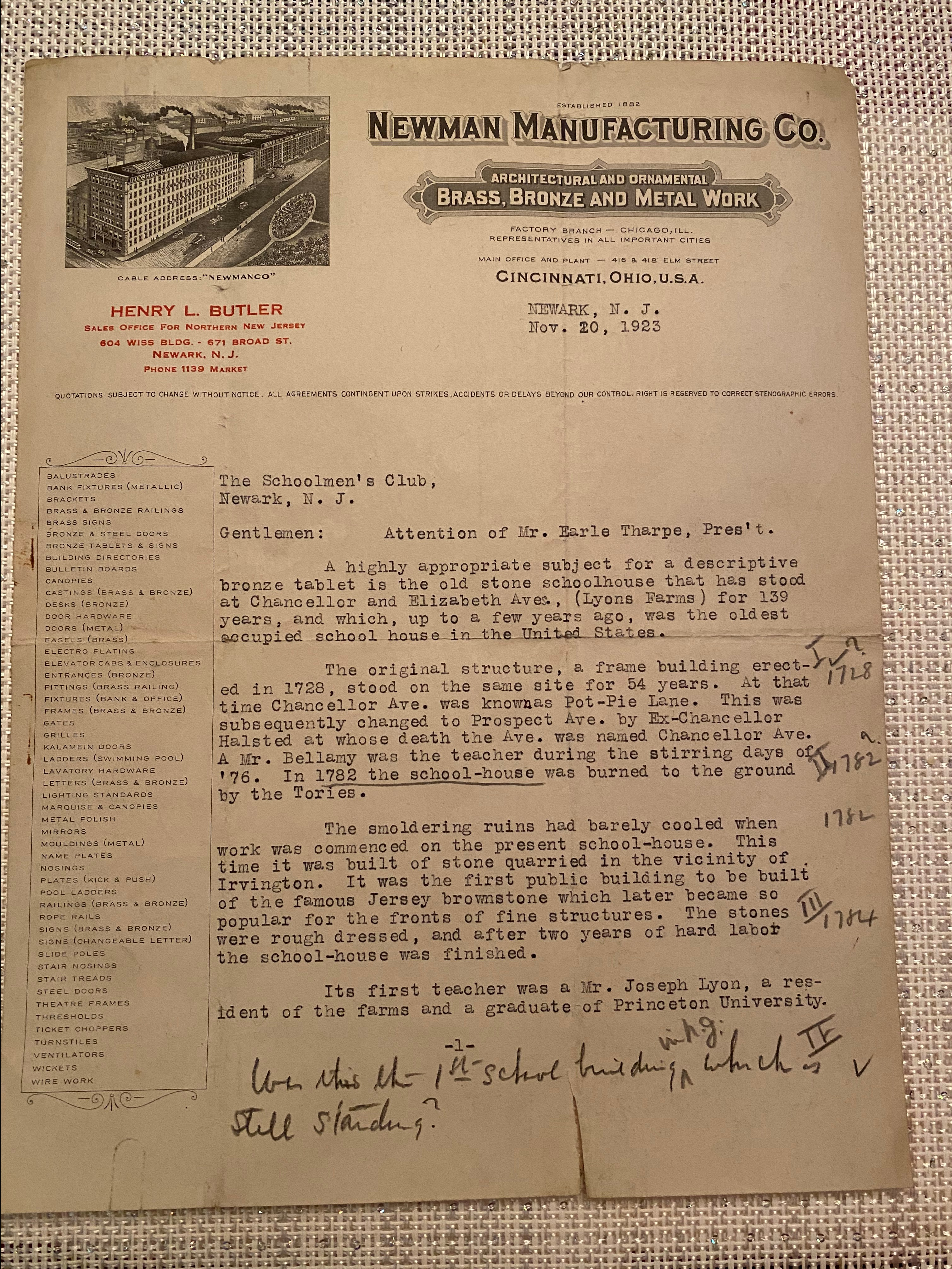
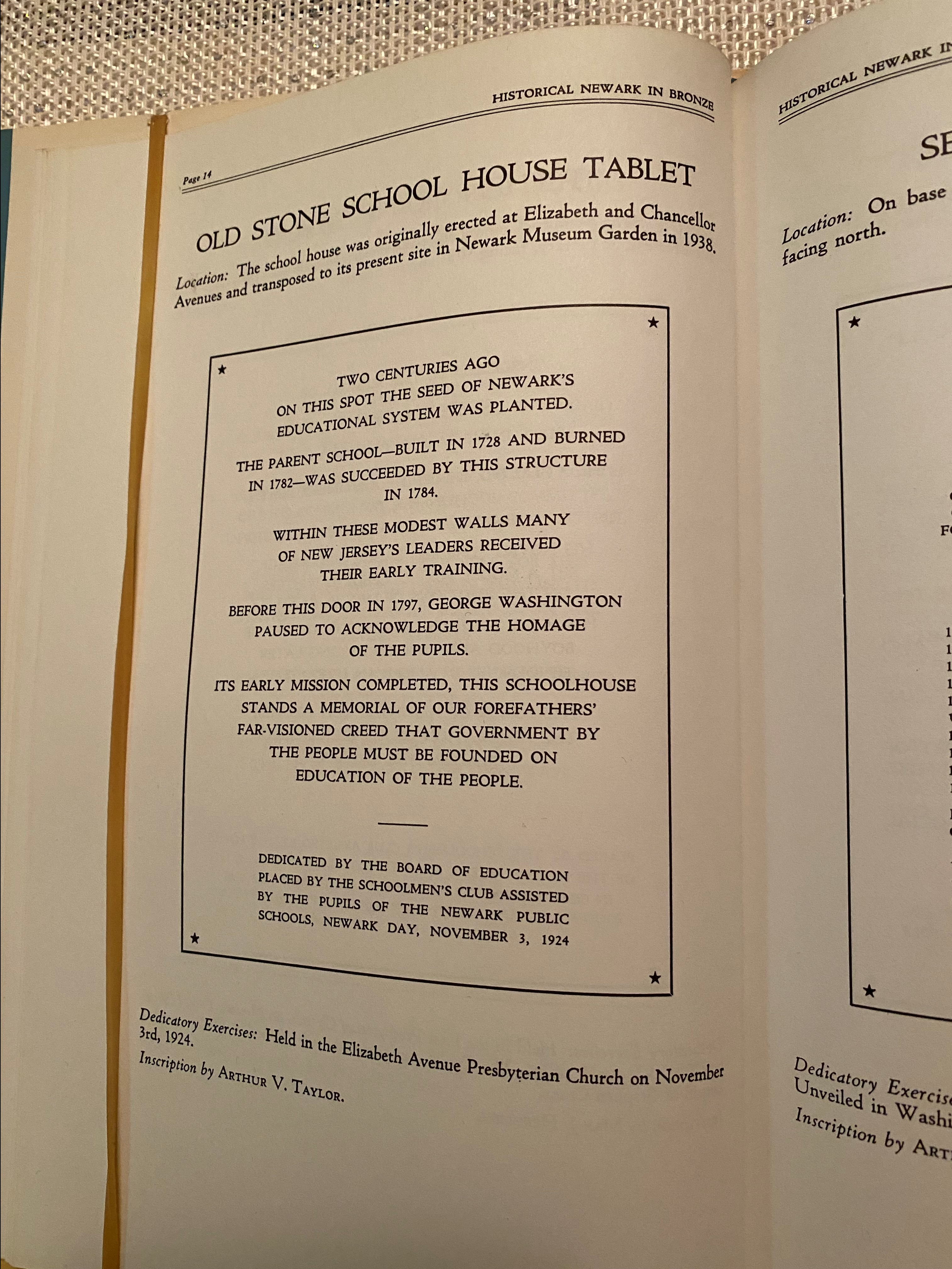
Education has several times been commemorated on these tablets. First was the Old Stone School House(1784), which stood for many years at Elizabeth and Chancellor Avenue and was moved, in 1938, to the garden of the Newark Museum. There is a tablet in the former Washington Park , now Harriet Tubman Square, to the first academy in Newark; this was set up by Newark Academy. A tablet in the previous Barringer High School Building(demolished 1964) commemorates the first high school in Newark- which may also have been the first public high school in the United States. This tablet was reinstalled in the new Barringer in 1965.
On May 17th, 1968 the final tablet created by the Schoolmen’s Club commemorating James M. Baxter was dedicated at Vailsburg High School.
On April 14th, 1828, Abraham King and John King applied to the Newark Town Meeting for assistance towards the education of poor African-American children, then numbering 50.The School for Colored Children as it came to be known, despite many difficulties continued to teach diligently the children in its charge. In 1830, Jacob D. King, a member of the same family, built a home on Warren Street, which later became a station on the Underground Railroad.

On October 24, 1864, Baxter accepted a teaching position at the State Street Public School in Newark, NJ. Two months later, Baxter was promoted to Principal at age 19. Baxter became so synonymous with the school that it came to be known as “Mr. Baxter’s School.” As principal, Baxter restructured the school’s curriculum making it more rigorous and upgraded the school building. In 1869, he and his assistant, Miss Marcia King, daughter of Jacob King, opened a night school so older, employed African-Americans could be educated. Indeed, Fanny Jackson Coppin ,American educator and missionary, described Baxter as having, “developed the school, and it became a very large one, ranking with the best in that city….he kept pace with all the modern systems of teaching and was rated by the educational authorities as a teacher of rare value.” Despite his efforts, Baxter was affected by racism and segregation implicit in the Newark Public School system. For instance, he earned a salary of $57.60 while white teachers earned a salary of $117.44. In 1872, Baxter helped to desegregate Newark High School when his student Irene Pataquam Mulford became the first African-American to enroll at the school. Baxter retired on July 1, 1909 after 45 years at the State Street School. His retirement forced Newark schools to desegregate since the State Street School, the only African-American school Newark, had to close. In addition, at the time of his retirement, Baxter was considered the “Dean” of Newark principals.
These bronze tablets begin with the days when Newark was still a wilderness and indigenous tribes wandered over trails that later became busy highways. They stretch down through the centuries that reveal Newark as a pioneer city -in its settlement by Connecticut adventurers and in the way in which its people have experimented boldly in industry, education, science, literature music and civic activities and have given distinguished service to the city and the nation. Although a number of the tablets are no longer extant, the story they told is well remembered.


0
 Newark's Attic
I expect that none of the bronze tablets survive to this day.
LikeLike
Hey Bill,
Although many are gone, there are still Schoolmen’s Club bronze tablets to be found around town.
LikeLike